March 9th – Saint Dominic Savio & Optional Memorial of St. Frances of Rome

Z domingo savio.jpg

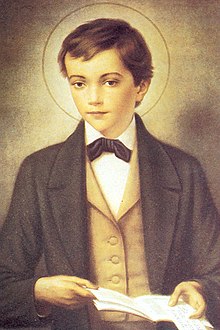
Today in the Holy Mother Church we have several saints in which to learn about and perhaps try to emulate in the way they lived their love of the Lord. There is the widely known Saint Dominic Savio, who died at the tender age of 15. He studied under St. John Bosco and was a role model for all young men.

When he was 12 years old he organized a group of boys into the Company of the Immaculate Conception. Besides his prayer life, he spent time working around the house, taking care of the menial tasks that often went overlooked by the other boys. “Religion must be about us as the air we breathe,” Don Bosco would say, and Dominic Savio wore holiness like the clothes on his back. “I can’t do big things,” St. Dominic Savio once said, “but I want everything to be for the glory of God.” His path to holiness was the way of the ordinary: cheerfulness, charity, fidelity in little things, helping others, playing games with good attitude, obeying his superiors.

Saint John Bosco used to tell the boys:  “Every one is called to be a saint, and do you know, it is easy to be a saint. Just do this: diligently do the ordinary things of the day in an extra ordinary way.” This heroism in the little things…is the stuff of holiness. As instructors of our children, we need to teach them at a young age, how to do the everything…the little things for the greater glory of God. Everyone of us has the capacity for giving glory to God…regardless of our place in life…regardless of our power or prestige.

St Dominic Savio, Patron of First Communicants

In 1857, at the age of fifteen, he caught tuberculosis and was sent home to recover. On the evening of March 9, he asked his father to say the prayers for the dying. His face lit up with an intense joy and he said to his father: “I am seeing most wonderful things!” These were his last words.

Another Saint whose feast can be celebrated today is the Feast of St. Frances of Rome. As a young girl, Frances sole desire was to become a nun and devote her life to God. But her wealthy family had other ideas, and when she was 12 years old, her marriage was arranged to  a wealthy nobleman.  Frances was distressed at the idea of not being able to consecrate herself to the Lord. When she complained to her father, he listened, but then asked her, why she would not do the will of God, and do as he told her out of obedience. She realized that he was right, and married Lorenzo de’ Ponziani. And though their marriage was one of arrangement, it was a happy marriage that lasted 40 years.

Frances had three children, and fulfilled her duties as a wife and mother with a charitable heart. During this time of being  a wife and mother, Frances continues to love the Lord, and serve Him by serving the poor. She also took care of those afflicted by epidemics and once opened her house as a hospital to care or the sick.

Saint Frances of Rome, Widow

On the spiritual side, Frances was gifted with visions. She was able to see her guardian angel regularly. It is said that her guardian angel used to guide her down the dark streets to care for the poor, with a lamp only she could see. When the plague hit Rome, and took with it two of her children, Frances sold most of her belongings to care for the sick. Her sister-in-law shared her same zeal for serving the Lord and the two of them worked together serving the needy.

When her husband Lorenzo died, Frances focused even more of her attention  on serving the needs of the sick and poor.She never shied away from caring for those who were sick, even when the disease could have spread to her, she continued on her mission of serving the Lord. She founded and governed the Congregation of Mount Olivet, and spent the rest of her life with her community. She died at the age of 56 in the year 1440. She was canonized on May 29, 1608 by Pope Paul V.

Saint Frances of Rome Circle

Quote: “A married woman must often leave God at the altar to find Him in her household care.”

Saint Frances of Rome is the patron saint of motorists, women, against plague, against the death of children, and of lay women.

Prayer to St. Frances of Rome
Bright jewel of the Order of Saint Benedict, illustrious Saint Frances of Rome, thou who wast led by divine Providence through various stations in life, that thou mightiest be a pattern of every virtue, to maidens, to matrons and to widows, pray for us to our divine Savior that we may be detached from the vanities of the world and may be able, under the guiding hand of our Guardian Angel, to grow daily in the love of God, of His Church and of our neighbor, and finally to be made partakers in heaven of the Felicity. Amen.

Posted in Catholic Feast Days | Tagged , , , , , , , , | Leave a comment

March 8th – St. John of God

March 8th can be celebrated as an optional memorial for Saint John of God. He was born in Portugal on March 8th in the year 1495. He was a very impulsive child, and one day when a missionary priest was traveling through his hometown, John was captivated by his stories of traveling the world, and at the tender age of eight, he ran away from home, leaving his mother heartbroken. He traveled much with the priest, but unfortunately he became too sick to continue on.

Luckily for John, the owner of a large estate was kind enough to take him in and nurse him back to health. John stayed on the estate working as a shepherd until he was 27 years old. Then feeling pressure to marry his manager’s daughter,he fled the estate. Led by an impulse, he was off to join the Spanish army as a mercenary. Living among the soldiers, John soon neglected his earlier religious guidance and training. He fell into a wild life of drinking, gambling and theft. Then, when an incident with a stolen horse, left him facing either imprisonment or death at the hands of his enemy, the thoroughly frightened John, impulsively vowed to amend his life…again.

At first, his fellow comrades did not care about John’s new found religious conversion, but they began to resent him, when he tried to get them to amend their ways, and soon he was thrown out of the army. With no money, he was reduced to begging to try and make his way home again. He wished to find the parents he had left so long ago. Upon arriving at his old hometown, he found to his great sadness, that both his parents had died. Some even went on to say that his mother died of a broken heart, when she lost her son so many years ago.

This news was quite unsettling for John. He was overcome with remorse and grief. It consumed him.It was during these years that he battled mental anguish and despair. It was so severe that it left him questioning his sanity. Filled with remorse, he gave away everything he owned and began to beat himself publicly. He would spend hours on the streets shouting, begging God for mercy, loudly repenting of his former life. Due to his actions, he was placed in a mental hospital for a short time. While he was there, Saint John of Avila visited him. He convinced John that the way to God was to serve the needs of the poor, instead of inflicting physical punishments upon himself.

File:Brooklyn Museum - St. John of God - Pedro Nolasco y Lara ...
Soon after, John received a vision of the Infant Jesus who called him John of God. He rented a house and converted it into a hospital for the city’s poor and destitute. He cared for all the sick and infirm, seeking out those who no one else wanted. Once, when someone raised a complaint to the archbishop about the kind of people that John was housing, John replied to the archbishop, “I know of no bad person in my hospital, except myself alone, who am indeed unworthy to eat the bread of the poor.”
detail from a painting of Saint John of God saving sick people from a ...

He continued to care for the sick and the poor for ten more years,until his death on March 8th, 1550. Known as the founder of the ‘Brothers Hospitallers of John of God‘ he also founded, ‘The Order of Charity.’ Saint  John of God is considered the patron saint of hospitals.

Prayer in honor of Saint John of God

Father,
you who gave John of God
love and compassion for others,
grant that by doing good for others
we may be counted among the saints in your kingdom.
Through our Lord Jesus Christ, your Son,
who lives and reigns with you
in the unity of the Holy Spirit,
one God, for ever and ever.
Amen.

Posted in Patron Saints | Leave a comment

March 7th – Feast of Saints Perpetua and Felicity

Saints Perpetua and Felicity

In the calendar of the Holy Mother Church, there are many lives of the saints memorialized each day. Unfortunately many of these saints’ stories are shrouded with mystery and legend. There are so  many saints in which there exists no recorded documents or facts of their holy lives. Often at times, it can be a bit overwhelming  trying to separate ‘the fact from the fiction’, as it were. But not so, with the lives of Saint Perpetua and Saint Felicity.

As they awaited their persecution, Saint Perpetua kept a journal of all the events leading up to their execution. Her diary, along with eyewitness accounts, is one of the oldest and most reliable histories of the suffering the martyrs endured during these pagan times. This document was passed down through the years and spread wide through the lands so as to encourage other Christians to bear witness to the world with their lives, and to teach others, that knowing Chris,t and serving Him, is greater than life itself.

Perpetua and Felicity’s ordeal took place in Carthage, Africa, in the year 202 or 203. It was a difficult time for Christians as the Emperor Severus had issued an anti-Christian law which forbade anyone to be baptized as a Christian. A young woman, Perpetua, who was 22 at the time, and her slave, Felicity were studying under their teacher, Saturus, to become Christians.  At the time of their arrests, Perpetua had an infant son, and Felicity was pregnant. Along with four other catechumens, they were arrested and sentenced to be thrown to the wild beasts in the amphitheater during a national holiday. At this time, deaths of Christians was viewed with the same spirit as one would view sporting events today. It was really quite barbaric.

Soon after their arrest, Perpetua and Felicity were baptized in prison by Saturus. During her baptism, she was told by the Lord to pray for nothing but endurance in the face of her trails. A few days before the execution, Perpetua’s father, who was a wealthy pagan pleaded with her to offer sacrifice to the pagan gods so she could be set free. She refused, saying   “Father, so you see that water jug over there? Could anyone call it by any other name than what it is? Well, in the same way, I cannot be called by any other name than what I am…a Christian.”

Saints With Rather Intense Stories | Mental Floss

Shortly before their scheduled executions, Felicity gave birth to a baby girl. During the difficult childbirth, she had cried out in pain. The guards mocked her and made fun of her asking her how she would ever endure the suffering of martyrdom. She replied, “Now it is I who suffer what I am suffering; then, there will be another in me who will suffer for me, because I will be suffering for Him.”

Santas Perpetua y Felicidad |

On the day of their execution, the martyrs left their prison “joyfully as though they were on their way to heaven” and entered the arena, where they were killed before the cheering crowd. Perpetua and Felicity were beheaded; while the others were killed by wild beasts. Today these women are mentioned in the first Eucharistic Prayer.

Holy Cards - Catholic Prayer Cards - St Therese of Lisieux - St ...

Father,
your love gave the saints Perpetua and Felicity
courage to suffer a cruel martyrdom.
By their prayers, help us to grow in love of you.
Through our Lord Jesus Christ, your Son,
who lives and reigns with you
in the unity of the Holy Spirit,
one God, for ever and ever.
Amen.


Posted in Patron Saints | Leave a comment

March 6th – Saint Rose of Viterbo

... New Third Order Franciscan Saint, Others in the Wings | On Pilgrimage

In reading about the lives of saints, sometimes we encounter a rare flower indeed. A person so touched by the grace of the Lord, that their whole life is a devotion to the Almighty God who made us. Saint Rose of Viterbo is one such saint. Born in 1235, about 40 miles north of Rome, to poor but pious parents. Little Rose showed remarkable gifts at a very young age. Her first words are said to have been Jesus and Mary. When she was just three years old her aunt died, and seeing how distressed her family was at the funeral, she went and stood over her aunt and prayed. The woman awoke and hugged her niece.

When Rose was seven she asked her parents if she would be permitted to spend hours alone so she could pray and. Her father built her a small cell in which she spent many hours doing penance and praying for the conversion of sinners. At other times she roamed the streets preaching about God. She wore a simple tunic with a rope wrapped around the waist and walked all over town, leading processions and praising God. She wanted everyone she met to turn away from their sin and follow God.

When she was ten years old she became very ill, and upon recovering she had a vision of the Blessed Mother, in which Mary asked her to join The Third Order of St. Francis. She was instructed to continue to live at home but to become an exemplary example of Christian life and holiness. It was during this time that she would wander around with a wooden cross and preach about how Jesus died on the cross for the sins of man. Several miracles are attributed to her at this time and her popularity grew.

During these years the political atmosphere was uncertain. The Emperor Fredrick II was in rule over the land and made Rome the ecclesiastical capital of the world. Pope Gregory the IX  excommunicated the Emperor and occupied her native land, Viterbo. By 1250, the city was in revolt against papal authority and sought to kick out the pope. When Rose, who was now almost a teenager, sided with the pope against the Emperor, she and her family were exiled from the city and went to live in Soriano nel Cimino. Rose spoke out against the Emperor more and more, and many miracles occurred around her.

But her outbursts against the Emperor, worried her father, and he threatened Rose with a severe beating if she continued her public outcries against Emperor Frederick II. Unafraid of the threats, Rose replied: “If Jesus could be beaten for me, I can be beaten for Him. I do what He has told me to do and I must obey Him.’ Finally the pope’s side won in Viterbo, and Rose and her family were allowed to return.

On December 5, 1250, Rose foretold of the impending death of the Emperor, a prophecy fulfilled only ten short days later. Soon afterwards, she heard stories of a sorceress who was casting spells over the citizens of Vitorchiano, and causing much harm among the peoples. Rose traveled there immediately and converted many of the people, but the sorceress would not convert. Before leaving the town, she worried that the sorceress would go back to her old tricks, so Rose built a fire and stood atop the burning fire for three hours singing songs of praise to God. Finally, it worked and the sorceress was converted!

When Rose was 15 years old she was anxious to enter the Poor Clares, but for some reason, they refused to admit her. Some historians contend that is was her family’s poverty that prevented her form being accepted, as her family could not afford the required dowry, others contend it was her failing health. Not to be discouraged the young Rose replied: “Well, it is fine, you will not receive me while I am alive, but you will receive me after I am dead.”

Saint Rose returned to her father’s house, and lived there in a private cell. She increased her prayer and mortification, and continued to pray for the faith of the Catholic Church, all the while, demonstrating great zeal for the Lord. A number of young women came to live with her, whom she instructed in the faith. At the young age of 18, Saint Rose died, having prophesied her own death. Her dying words to her parents were: I die with joy, for I desire to be united to my God. Live so as not to fear death. For those who live well in the world, death is not frightening, but sweet and precious.”

Two and a half years after her death, she appeared three times to Pope Alexander IV, who was in Viterbo, and told him to have her body moved to the convent of the Poor Clares. When this was done, her body was found to be incorrupt. It has remained in the same condition for all these years.  And many years later in 1921 when her heart was removed to be placed in a reliquary for a procession, it was found to be unblemished. Miracles are constantly reported at her tomb. Pope Callistus III canonized her in 1457.

As we look at the life of this beautiful saint, we find her life to be one of simple grace and a life lived in the presence of the Lord. Even while just a toddler, she showed such remarkable connection to the Will of the Father. Her life was such an inspiration, for even though she did nothing bignothing  grandshe did all things in a grand way...she did all things for the Lord…She did not influence kings and majesty…yet she defended the papacy…the Holy Mother Church, suffering exile for her dedication and support. And while she was never able to establish  a religious order, as she had hoped, she was able to unite her life…all her joys…all her sufferings… to the Lord.

The short life of Saint Rose should serve as a reminder to us…the ordinary faithful…that we can…and we should lift up our daily tasks…our daily struggles, to the Lord and consecrate all that we do…so that we too…may grow closer to the one Who made us…and unite ourselves with Him …living with the hope that we may also become a beacon of Christ’s Light for others to follow. Saint Rose of Viterbo, pray for us!

Heavenly Father,
in the youthful Saint Rose, Your servant,
You combined wonderful courage of soul
and unsullied innocence.
As we celebrate her merits
may we imitate the example of her virtues.

Posted in Patron Saints | Leave a comment

First Sunday of Lent – March 5th, 2017

                                                                 The Temptation Of Christ Temptation of christ - vasily

                                                                Gospel  Matthew 4: 1-11

At that time Jesus was led by the Spirit into the desert
to be tempted by the devil.
He fasted for forty days and forty nights,
and afterwards he was hungry.
The tempter approached and said to him,
“If you are the Son of God,
command that these stones become loaves of bread.”
He said in reply,
“It is written:
One does not live on bread alone,
but on every word that comes forth
from the mouth of God
.”

Picture of a stone and a loaf of bread

Then the devil took him to the holy city,
and made him stand on the parapet of the temple,
and said to him, “If you are the Son of God, throw yourself down.
For it is written:
He will command his angels concerning you
and with their hands they will support you,
lest you dash your foot against a stone
.”

Jesus answered him,
“Again it is written,
You shall not put the Lord, your God, to the test.”
Then the devil took him up to a very high mountain,
and showed him all the kingdoms of the world in their magnificence,
and he said to him, “All these I shall give to you,
if you will prostrate yourself and worship me.”
At this, Jesus said to him,
“Get away, Satan!
It is written:
The Lord, your God, shall you worship and him alone shall you serve.”

... desert and he remained in the desert for forty days tempted by satan

Then the devil left him and, behold,
      angels came and ministered to him. Matthew 4:1-11

11 (NKJV) 11 Then the devil left Him, and behold, angels came ...

In today’s Gospel reading we are brought to the desert where Jesus has been ‘led by the Spirit into the wilderness,‘ and has been fasting and praying for forty days. We would think that one would be weak at this point. To be in the rugged desert conditions without food or rest for this length of time, one would think that Jesus might be in a weakened state, which He is, and that is precisely why the devil appears at this moment in time. Having seen the state in which Jesus is in…he offers Him three temptations, hoping to catch Him with His guard down. Though Jesus is weary and reduced by the forty days of fasting, He is also strengthened by it… strengthened by the Holy Spirit that has led Him there. For at every turn of the devil, Jesus redeems three great failures of mankind.

In the first temptation, we find the devil, cleverly trying to create doubt in the heart of Jesus, with his words “If you are the Son of God…turn these stones into bread…and feed your hunger”… The devil is attacking Jesus on many levels. First, he wants to try to create doubt in Jesus’ head about the role of His true identity as the Son of God….the devil continues further trying to get Jesus to give into His hunger…to give into a desire of the flesh. But Jesus combats this with His response that  ‘man cannot live on bread alone, but on every word that comes forth from the mouth of God’…bringing us back to the Israelites and their rebellion against God and His manna that He fed them in the desert. But unlike the Israelites, Jesus does not rebel against the Lord for having ‘led Him to the desert.’ Instead He uses the words of Scripture to deflect the temptations of the devil. By doing so, Jesus is not only showing His reliance upon, but also, His adherence to the Word of God.

Next the devil tries to trick Jesus into tempting God. He is once again trying to get Jesus to doubt  His importance to the Father…’throw Yourself down…surely Your Father will command the angels in Heaven to guard You’… Once again, Jesus does not fall into the trap of pride with these words from the deceitful devil. Unlike Adam, who was led by his own pride, Jesus understands His place as the servant of the Father’s Will, by refusing to bend to sin… He is replacing the first Adam…thus repairing the first sin of mankind…pride.

Golden Calf (610×350)

Finally the devil tries to deceive Jesus with promises of wealth and power. Jesus understands that it is not His place to usurp the power of the One Who sent Him. Unlike the Israelites, who fell back into their faithless worship…their idolatry, when they turned their back on God and the prophet Moses, and fell back into their  worship of the golden calf. Jesus is able to recognize that all worship and praise…all glorybelongs to the Father. Again He uses Scripture passages to rebuke the devil, once again showing His adherence to the Word of God.

The timing of this reading is so perfect for us…Once again, showing us the marvelous ways of Our Holy Mother Church… Just as we are about to endeavor on our own forty days of fasting (maybe) and praying…we are given the perfect example of how to entrust our lives…our entire being, to the One Who made us…we can do nothing without GodHis Words…His Spirit…these gifts of God are what will get us through…Not just these forty days…but our entire  lives.

With man’s pride and sinfulness, the Devil has done much to reshape the world, turning it away from God and His plan of Salvation…Satan uses every trick and temptation to ensnare man. We now have a world where God has been stripped from every public fountain…stripped from every public event…we are left with a vast and Godless abyss…where truths are intertwined with deceit...all in Satan’s desire to bring about man’s demise and God’s defeat…

It is here we find ourselves, as in the desert…trying to keep our thoughts focused…our minds pure….our hearts holy….What better way to achieve this, and combat the devil, than to renounce the promises of the evil one…and reclaim our place at the foot of the Cross….at the foot of our Redeemer….holding onto the Blessed Mother, and all the other Holy Saints who have found there way there.. allowing ourselves the burdens of this world…without compromising ourselves to its empty promises...and join with them who have found their way…their path…(the narrow gate) to their eternal salvation that only Jesus Christ can avail through His Most Perfect bride…The Holy Catholic Church.

Posted in Daily Gospel Reading | 1 Comment

Saint Ciaran March 5th

St. Kieran of Saigir - Saints & Angels - Catholic OnlineMarch 5th is the traditional day in the Holy Mother Church in which we recognize Saint Ciaran, but since it falls on a Sunday this year, we forgo the saint’s feast  and instead celebrate the paschal mystery of the death and resurrection of our Lord Jesus Christ, because that is the basis of our Christian faith. But since our family has a personal attachment to Saint Ciaran, I wanted to share a bit of his history with you today.

Not much is known of this saint, except that he is often referred to as  “the first born saint of Ireland,”he is also know as ‘Ciaran the elder’ as to not confuse him with Ciaran of Clonmacnoise. Saint Ciaran traveled to Tours and Rome to learn about Christianity. It is believed that he was baptized there. Upon his return to Ireland, he built himself a small cell and lived as a hermit in Ossory. He was joined by several other devout men and they formed a monastery. He also founded a monastery for women, which he placed under the direction of his mother.The life of this saint remains a bit obscure and there are contradicting details about when he was ordained a bishop but according to some writers, he was one of the twelve consecrated by Saint Patrick to help him in Ireland.

There are many legends surrounding this saint. One such legend is that a kite (a bird of prey) flew above the young Ciaran and swooped down near the boy and picked up a small bird that was sitting on her nest. This upset the young  Ciaran terribly and he yelled to the kite to drop the bird, and the kite turned back and dropped the small bird in front of the young saint, where upon he bade the small bird to rise and be whole. The small bird stood and flew back to the nest  from which it had been plucked. Another legend tells the story of a fox a badger and a wolf who worked with Saint Ciaran and his monks to help cut wood and to help in the building of huts for the brothers.

The date of Saint Ciaran’s death is uncertain but he is believed to have died of natural causes at the age of ninety sometime around the year 490.

Posted in Uncategorized | Leave a comment

Feast of the Crown of Thorns – Fri. March 3

The King Who Did Not Bow Down -- A Biblical Reflection on the ...

As we start to settle into our ‘Lenten’ routine, of fasting, abstinence, and the Stations of the Cross on Fridays, let us add yet another traditional way to recognize the Lord and His immense suffering for us, with a special day set to honor His crown of thorns on this First Friday of Lent.

The Feast of the Crown of Thorns was instituted in France in 1239, when King St. Louis IX, recovered the relic of the Crown and brought it back to France where it was later placed at the Royal Chapel along with other relics of Our Lord’s Passion. It was celebrated throughout northern France on August 11th. The following century another festival of the Holy Crown was instituted on  May 4th and was celebrated in parts of Spain, Germany and Scandinavia, along with the Feast of the Invention of the Cross. Several Dominican communities in Spain still observe this feast on April 24th.

“In that day the Lord of hosts shall be a crown of glory and a garland of joy to the residue of His people.”

In the Diocese of Freising in Bavaria a special feast was granted by Clement X in 1676 and then in 1689 Innocent XI granted a feast in honor of the Crown of Christ, which was celebrated on the second Friday of March. Then in 1831 it was adopted in Rome as a double major and observed in areas on the Friday following Ash Wednesday. As it was not celebrated throughout the universal Church, the Mass and Office are placed in the appendices to the Breviary and the Missal.

Divine Mercy Apostolate: The Crown of Thorns

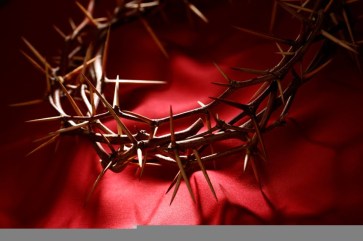
As we enter into Christ’s Passion this First Friday of Lent, let us contemplate not only the burdensome Cross He bore for us, but also, the crown of thorns they twisted together and fit Him with, on our account. From the Gospel we learn that the thorns sprang forth from the sin of our first parents, Adam and Eve, planted by the Devil, but grown long and sharp under a curse from God. A wise reflection from St. John Chrysostom states: “when God said to our fallen parents: Cursed is the earth in thy works, thorns and thistles shall it bring forth to thee.” He intended to signify: thy conscience O sinner, shall never cease producing thorns and stings which will prick thy guilty soul.( St. John Chrysostom, Mark 10:19)

As we contemplate the life of Christ, we find that he was born into poverty and bore no resemblance to the royal King that He truly is. His whole mortal life was spent in the clothes of a sinner, and as a remedy for the sins of man, He drank daily, large doses of the disgusting potion that was squeezed from the hearts of corrupted, sinful men, that He was intended to save. Though this vessel was vast and deep…it could not contain the many sins of man, as they kept replenishing the sins every moment of every day. So Jesus, out of obligation to the Father, and because of His great love for us…made a most painful effort to drain it all at once with His most bitter passion. But that was still not enough! The sins of man were many!  And in order to drain it completely, He offered to be completely emptied of His life’s Blood…every last drop of It. His Precious Blood would have to be squeezed from every pore of His Body to make up for the sins of man…to make up for our sins….and the crown of thorns was made.

Crown Of Thorns Quotes. QuotesGram

That’s a difficult Truth to swallow…that we…you and I… are responsible for all the anguish, all the suffering…for that horrible crown of thorns! Fashioned by our own sinful hands…the thorns are a sign of our sins. Allowed to be placed there by a loving God. A God Who longs for us to make amends…Who longs for us to be saved from our sins. The Lord desires that each of us should be with Him in Heaven…and it is precisely because of this unfathomable love, that He took these sharp thorns upon His adorable head.

crown-of-thorns.jpg

In that day, the prophet Isaiah says, ‘The Lord of Hosts shall be a crown of glory, and a garland of joy to the residue of His people.” Isaiah 28:5

Saint Jerome says with reason “Through the merit of the thorny crown of Jesus’ head we have acquired a right to the diadem of the Heavenly Kingdom.”

With the crown of thorns, Jesus removed the curse and changed it into a blessing for mankind. In this way Our Lord Jesus Christ, diminished the quantity and the intensity of our temporal sufferings…through His anguish…His suffering…. His pain…he was able to transform it all into a blessing. With His immeasurable  grace…He has opened for us, the doors to Heaven…our Eternal Reward!

French First Bishop of Lahore Jesus Christ with thorn crown

The Crown of Thorns Prayer

Dear Lord, I am grieved when I consider Thy sad condition when Thou wore the Crown of Thorns upon Thy holy Head.  I desire to withdraw the thorns by offering to the Eternal Father the merits of Thy Wounds for the salvation of sinners.  I wish to unite my actions to the merits of Thy Most Holy Crown, so that they may gain many merits, as Thou hast promised.  Amen.


Posted in Uncategorized | Leave a comment

Blessed Charles the Good of Flanders – March 2

Today as we embark on our first full day of lent, the Holy Mother Church celebrates Charles of Flanders or Charles the Good as he was widely called because he ruled his people with equity, loyalty and love.  As we vow to turn our own hearts and wills to the Lord, it seems fitting to learn about a man who loved God with such an open heart that he felt compelled to treat everyone…rich and poor alike with kindness and justice.

Charles was born in Denmark in the year 1083. His father was Saint Canute, King of Denmark. His father was an ambitious ruler who was devoted to the Catholic Church and built many churches and monasteries. But when Charles was only five years old, rebels forced his family out of Denmark and killed his father. His mother took Charles to the court of her father, the Count of Flanders in Bruges,which is in the northwest part of Belgium, to be reared.

Charles grew up in the court, learning the life of royalty, but he also devoting  daily time to prayer and religious observances. As he grew and reached the age of service, he became a Knight  and accompanied his uncle on the Second Crusade. When he returned, he was assigned as Count of the country of Flanders.

Count Charles had a profound love for justice. Every day after dinner, he would meet with several theologians who would explain two or three chapters of Scriptures. He relished these lessons and took great pleasure in learning all he could about the Gospels. He abhorred blasphemy and would sentence anyone taking the name of God in vain to forty days of bread and water. If they did not repent and convert their ways, he would have a foot or a hand removed, to serve as a constant reminder to the people that this person was a blasphemer against God. But remember, he always gave the person a chance to repent of their ways before taking such drastic measures.

He was a very just ruler and took care of the poor, the oppressed, the widows and the persecuted orphans. If he caught someone taking advantage of any of these groups, he punished them severely but justly. He was a man who led by example, and did not expect anything greater from his subjects than what he himself would do. He was a man who chose to lead more out of good example than out of power. When his critics said he was over doing the charity, he replied, “It is because I know so well the needs of the poor and the pride of the rich.”

In the years 1124-1125, the winters were very brutal, and a terrible famine followed. Charles set up feeding stations at each of his castles, feeding hundreds of people each day. At one point it was recorded that  he gave out 7800 loaves of bread in one day.

Charles’ castle in Bruges

As a sign of his daily penance, Charles went barefoot and wore the clothing of peasants. He attended Mass each day, relying on the priests and clergy he encountered to correct his laws if they violated the teachings of the Scriptures. He was so convinced of the power of forgiveness, that he established that all convicted criminals sentenced to death were to confess and receive communion on the day preceding the execution of their sentence.

During this time of famine there were  several families who hoarded grains so that they could sell them at exorbitant prices to the people. When Charles found out about this, he enacted new laws to prevent this sort of price gauging. Of course this did not go over too well with these families. So they joined forces with others who had been punished by Charles and plotted to kill him.

One day in 1127, as he was walking to the church for morning Mass, a friend stopped him to warn him that there was a conspiracy planned against him. He replied “We are always in the midst of dangers, but we belong to God. If it is His Will, can we die in a better cause than for justice and truth?” And continued on his way to Mass. Arriving at the Church of Saint Donation, he knelt before the Our Blessed Mother’s alter and prayed the psalm of mercy; the Miserere. It was at this point that the conspirators charged in, swords drawn. Before Charles could even react, Borchard, a nephew of one of the families, beheaded Charles as he knelt before the alter. Another of the attackers cut off his arm.The reign of the good and just King was over.

The life of Blessed Charles the Good reminds each one of us, that we are all called to be ambassadors of the truth. We are called to do this by aligning ourselves with the Holy Mother Church and making sure we share the Truth of the Gospel with everyone. We are all called to help our neighbor…the poor and downtrodden of our society. Charles the Good often left the comforts and luxuries that were afforded him as royalty in order that he better serve his fellow man, whom he considered his equal.

Charles, felt that the authority to govern came from the Lord, and that all men will have to answer to God for their actions. We need to pray that our own elected officials will be men of prayer and Faith. We need to ask the Lord to protect our leaders who rely on Him for guidance. We need to pray for any of our leaders who show a devotion to the Lord, that they be protected from the current tide of hostility. Remember, Charles was loved by many, and yet it took only a few outraged  men to end his life.

As we journey on our own paths, let us always remember that the journey may not be easy.It is very likely that, if you are following the Lord, it will be difficult…not only the obstacles that hinder you…but more often than not, people will be offended by the  Truth that you are revealing to them…so be kindlet charity guide your words…your actions...and remember…as Blessed Charles stated, “We are always in the midst of dangers, but we belong to God.”

Posted in Patron Saints | Leave a comment

Saint Eudokia of Heliopolis – March 1st

St. Eudocia Orthodox Icon » Mounted Orthodox Icons of E-F Saints ...

One of the many saints recognized on March 1st is Eudocia of Heliopolis. She was a pagan, Samarian woman who was very beautiful. She gained much of her fortune by attracting wealthy suitors. She lived a very immoral lifestyle in young adult years, using her beauty to lead others into sin and amassing a large amount of riches.

While bedridden and suffering a major illness she heard beautiful music coming from the neighbor’s house. It captivated her and when she was well enough, she went to her neighbor’s house and was introduced to a Monk named Germanos, who was staying with the neighbor. This introduction, peaked her interest and according to legend, she asked the monk if someone like her could be saved from Judgement. Under his guidance she learned much about Christianity. At one point, he instructed her to remain alone in her chamber for one week, and do nothing but fast and pray. She followed his instructions and at the end of the week, she had a vision about the Archangel Michael. In this vision, she saw the Archangel leading her to heaven while many angels were rejoicing. This vision assured her that Christ loved all people…including sinners like herself. She repented of her ways and was baptized by Bishop Theodotos. After her baptism she had a vision of a dark shadowy figure howling because he had been cheated of gaining her soul for hell.Eudocia turned from her sinful life and entered the monastery and took upon herself strict acts of penitence. The Lord granted her forgiveness and endowed her with many spiritual gifts when she became a nun.

Soon after she commissioned the building of a monastery near Heliopolis, and used much of her wealth ministering to the poor. Even though she was a nun, her beauty and wealth still attracted many suitors. One such suitor,a young pagan, Philostratos, was very persistent and refused to leave her alone. One day aflame with passion, he came into the monastery disguised as a monk and began to urge her to return to Helioplois to resume her former life. “May God rebuke you and not allow you to leave these premises,” Eudokia cried. Philostrates fell down dead before her as if struck down by the hand of God. Eudocia, fearing that  she had served as an accomplice to murder, prayed for him and he recovered. Shortly after this episode, he followed her example and converted to Christianity, never forgetting the mercy that God showed him.

... Илиопольская / St. Eudocia of Heliopolis (Mar 1/14

For many years; because of her many spiritual gifts from the Lord; Eudocia was able to persuade many pagans to convert to Christianity. This eventually got the attention of the Roman officials, who were angered by her actions. When she refused to stop evangelizing the pagans, she was sentenced to death by beheading. She was martyred in 107 A.D.

PRAYER TO EUDOCIA

O Eudoxia, when godly fear entered your heart,

You abandoned the glory of the world,

And hastened to God the Word.

You took his yoke on your flesh

And shed your blood in a contest surpassing nature.

O glorious martyr,

Entreat Christ our God to grant us His great mercy. Amen.


Posted in Patron Saints | Leave a comment

Ash Wednesday – March 1st

... Catholic Priests Need For Ash Wednesday | Traditional Catholic Priest

Today in the Holy Mother Church we observe Ash Wednesday with prayer and fasting as we begin this Lenten season, which is the penitential time leading up to Easter.  We crowd into the Churches with all the faithful, those who are practice their faith daily and those who may have fallen on their way, but still long to unite themselves to God and His mercy…if but, just for a moment...Together we participate in the solemn act of receiving ashes on our foreheads. We allow the priest to mark us with the blessed ashes as a sign of our desire for conversion. It is a public sign of penance and shows our willingness to let go of our sins and conform our hearts to God. Remember...it is an outward sign of our own humility.

The ashes are a sign of God’s Truth in each of us. With this mark, we are telling the world that due to our inclination to sin,  we have fallen short of His plan for us, and we have come to seek His mercy…His forgiveness. We are proclaiming that with this period of forty days, we are going to amend our lives..by turning away from what separates us from Him, so that we can rejoice with Him on Easter…and celebrate the Truth, that it was He, Who saved us from our sins. This act of penance also unites us to one another by proclaiming with this black smudge of ‘dirt’ on our foreheads, that all of us are going to leave this world in the same way…through death…it is our public proclamation to the world that we are but sinners, and but mere dust, without the Lord.

It is by no means a sign of celebration…it is a sign of our repentance…a getting down on our knees before the Lord….and seeking His forgiveness, sign. It is a sign to the world that we are not ashamed to follow Christ. And it can be hard…just try walking through the grocery store with young children with ashes on their foreheads and just watch how quickly they wipe the ashes from their foreheads…trust me, it is not a bragging competition.

Ash Wednesday

The act of putting ashes on the foreheads of the faithful symbolizes our fragility and our morality…we are stating to the world, that in fact we are in need of God’s mercy to be redeemed. But it is not only an external act. We must have an attitude of internal repentance during these coming forty days that lead us to Easter.

Lent is a time for us to deny ourselves the pleasures of this earth. Those of appropriate age and health are required by Church law to abstain from meat (on all Fridays of Lent), and those between the ages of 18 and 59 are obliged to fast. Since Vatican II these rules have been relaxed and we are just required to limit our intact of food to three small meals on Ash Wednesday and then again on Good Friday, the days of total fasting are no longer required, but are permitted.  We should add prayer to our daily routine, if we haven’t already. During the Lenten season many churches hold Stations of the Cross on Fridays, which is a perfect way to meditate on Christ’s suffering and passion. It is also a good time to add an hour or two of Adoration of the Blessed Sacrament, each week. What better way to aid in our conversion, than to kneel before the Heart of the One who made us. Those quiet moments of contemplation and prayer can really help us put into perspective what matters in this life…it can help us to better focus our hearts and our minds in making this our best Lent ever.

PRAYER FOR ASH WEDNESDAY

Almighty and everlasting God,
you hate nothing you have made
and forgive the sins of all who are penitent:
Create and make in us new and contrite hearts,
that we, worthily lamenting our sins
and acknowledging our wretchedness,
may obtain of you, the God of all mercy,
perfect remission and forgiveness;
through Jesus Christ our Lord, who lives and reigns
with you and the Holy Spirit, one God, for ever and ever. Amen.
1979 Book of Common Prayer

Posted in Uncategorized | Leave a comment